Choosing an AnnounceKit Alternative Built for Multi-Channel Product Communication
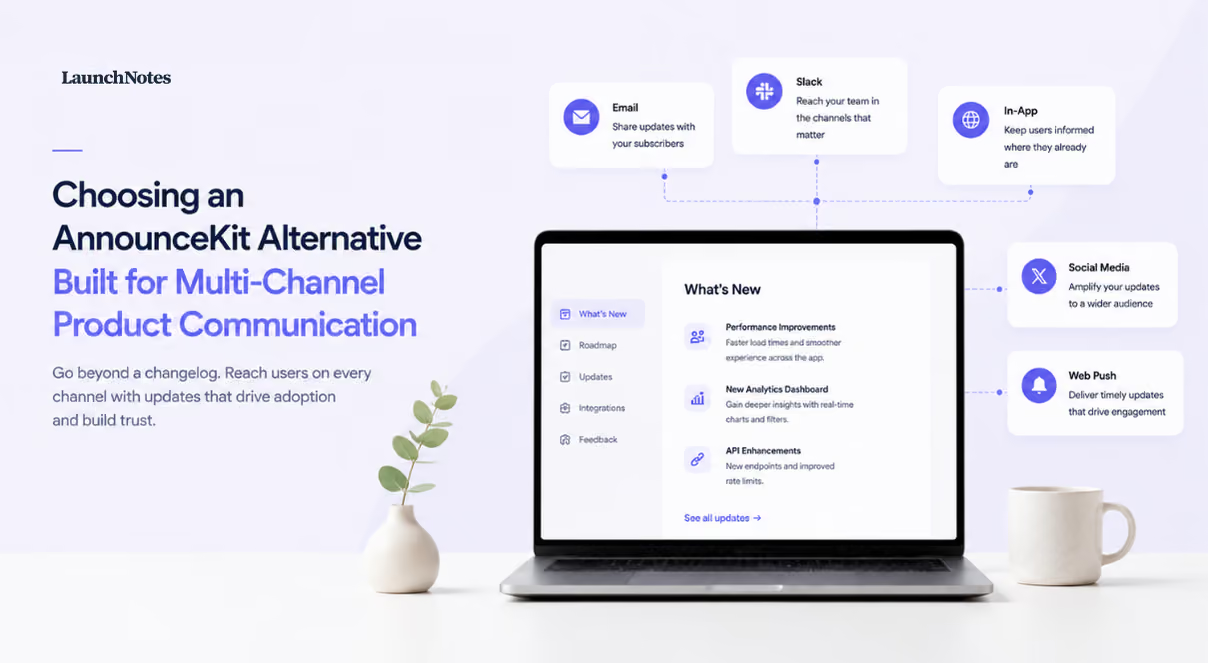
Most teams shopping for an AnnounceKit alternative are not unhappy with the widget. They are unhappy that the widget turned out to be the whole job. The release note goes out, the in-app badge lights up, a few people click, and then the next question arrives from support or sales: where does the customer see what is coming, and where do they tell you what they want next? That is the decision, and it has a single condition attached. If publishing a changelog is genuinely the only thing you need to do, the case for switching is weaker than the comparison pages suggest. If roadmaps, feedback, and stakeholder updates need to live in the same system as your release notes, you are not shopping for a better widget at all.
So compare on the things that actually change your workflow: which channels each tool can reach, whether a roadmap and a feedback loop are included or bolted on, how the pricing shape behaves as your team grows, and how much of the feature list your plan tier actually unlocks. Everything below is organized around those questions rather than around feature checklists.
What AnnounceKit Covers and Where Teams Hit Its Ceiling
AnnounceKit is a changelog and in-app update tool, and it is a capable one within that boundary. Its own material counts more than ten ways to display updates inside an app, which is not marketing filler when your product has three surfaces and a mobile web view to account for. Competitors concede the strength too: FeatureOS, in its own comparison, lists AnnounceKit's advantages as Advanced widget customization, User segmentation, which tells you where the engineering effort has gone. Userorbit's comparison draws the boundary more sharply by category, describing AnnounceKit as embeddable change feeds against its own framing as an announcements and engagement platform, and listing AnnounceKit's channel coverage as widgets and email while its own runs across in-app, portal, and email.
The ceiling shows up in two places. The first is scope: a widget plus an email send gives you distribution, but it does not give you a destination customers can browse, a roadmap they can follow, or a path from a feature request to the announcement that closes it. Userorbit's comparison names product marketing and customer success teams as AnnounceKit's ideal user, which is telling, since those are exactly the teams who get asked what is shipping next quarter. The second is cost timing. AnnounceKit's Scale plan runs $339 per month billed annually, or $399 billed monthly, and its pricing model is otherwise described as custom in Userorbit's comparison. Reaching a growth-stage line item before you have bought a roadmap surface or a feedback loop is the moment most evaluations start, and it is a reasonable moment to widen the search rather than upgrade.
In-App Announcements Across the Alternatives
In-app delivery is where these tools look most alike and behave most differently. A widget is a component: it interrupts, it shows a feed, it clears the badge. A portal is a place: the customer arrives, reads the update, and can keep going into adjacent context without leaving the session. Userorbit's comparison puts the difference plainly in its channel row, in-app, portal, and email on one side against widgets and email on the other, and the practical consequence is what happens after someone reads the note. With a standalone widget, curiosity has nowhere to go. Your support team fields the follow-up instead.
Two caveats belong here before anyone treats portal coverage as a clean win. Mobile is unsettled across the category, and Userorbit's own comparison marks mobile application support as limited for both Userorbit and AnnounceKit, so a mobile-first product should treat any in-app claim as something to verify in a sandbox rather than accept from a table. And customization depth is not evenly distributed; AnnounceKit's widget flexibility is the specific thing FeatureOS's comparison concedes, so a team that has already tuned its widget to match a design system may find the replacement blunter. FeatureOS offers a 30-day free trial, which is long enough to load real release notes into it and see whether the in-app presentation holds up next to what you already ship.
LaunchNotes approaches the same problem from the destination side. A product hub gathers release notes, announcements, and roadmaps into one branded place, so the update and the context around it are the same artifact rather than two systems your customer has to reconcile. No more scattered product updates is the point of the design, not a slogan attached to it.
Email Notification Depth and Tracking
Email is the channel buyers underestimate during evaluation and then rely on constantly afterward, because it is the only one that reaches users who are not logged in this week. Every tool in this comparison can send an announcement email. The question worth pressing is what comes back: whether you can see opens and clicks per announcement, whether you can tell which segment engaged, and whether that data is visible to the product marketer who wrote the note or only to whoever owns the marketing automation stack. Public comparisons of AnnounceKit and its alternatives are thin on tracking depth, which is a reason to test it rather than a reason to assume parity.
Be specific in the trial. Send one real update to one real segment, then ask the tool who read it. If the answer is a total send count, your product marketing and customer success teams have no per-announcement engagement signal, and they will keep guessing whether the low adoption on a new feature is a discovery problem or a messaging problem. At $339 per month for AnnounceKit's Scale plan, that answer should not require a data pull.
LaunchNotes handles notification as a routing decision rather than a single channel, with Slack and email notifications and analytics available depending on plan. Check the tier you are actually buying, because notification channels and reporting depth vary between plans across this whole category, not just this one.
Roadmap Functionality as a Differentiator
Roadmap is the cleanest dividing line in this evaluation, and it is the one that most often decides the purchase. When a roadmap lives in a different tool from your changelog, you are running two publishing workflows, two sets of permissions, and two subscriber lists that drift apart within a quarter. Someone announces a shipped feature that the roadmap still shows as planned, and a customer notices. Consolidation is the whole argument for switching, and ReleasePad's roundup makes it directly, listing Featurebase's edge over AnnounceKit as Deeper feedback, roadmap, and survey tooling in one place along with a free plan and a low entry price for very small teams.
Featurebase is not a free win, though, and the same roundup is candid about the tradeoffs: per-seat pricing climbs with admins, the changelog is one module inside a broad suite, and there is no commit-to-changelog automation. A changelog that is one module among many tends to inherit the suite's conventions rather than the release manager's, which matters if your notes are customer-facing marketing artifacts rather than internal records. FeatureOS is worth putting through its 30-day trial for the same reason: publish a roadmap item, move it to shipped, and watch what your subscribers actually receive.
LaunchNotes centralizes release notes, roadmaps, and feature updates, which means the roadmap item and the announcement that retires it are two states of the same object instead of two documents maintained by two people. Announcements, roadmaps, customer feedback, integrations, webhooks, GraphQL, RSS, and security features are all part of the platform depending on plan, so the consolidation argument holds only if you buy the tier that includes the pieces you are consolidating.
Feedback Collection and Closing the Loop
Feature request intake is easy to add and hard to close. The loop that matters runs from a request, through prioritization, onto a roadmap, into a release note, and back to the specific people who asked for it. Break that chain anywhere and you get the failure mode every customer success lead recognizes: a customer churns three months after the feature they requested shipped, because nobody told them. When feedback and changelog sit in separate tools, closing the loop becomes manual coordination, someone cross-referencing a request list against a release note and sending the follow-up by hand.
Featurebase's pitch is that the feedback portal and the changelog are the same product, and ReleasePad's roundup credits it with deeper feedback, roadmap, and survey tooling in one place for exactly that reason. Tools whose center of gravity is feedback prioritization solve the intake and voting side well, but announcement workflow tends to be the secondary module there, so evaluate the release note editor and the send controls as carefully as you evaluate the voting board. AnnounceKit's segmentation strength is relevant to the same problem from the other direction, since knowing which cohort requested something is what makes the closing message worth sending.
There is also the honest low-cost option, which ReleasePad includes in its list of seven alternatives: write your own using a Keep a Changelog format on a static page. It works, it costs nothing, and it gives you no subscriber list, no segmentation, and no loop back to the people who asked. Choose it deliberately or not at all.
LaunchNotes keeps customer feedback in the same platform as release notes and roadmaps, so the request, the plan, and the announcement share one system of record and one audience list rather than three.
Per-Seat Pricing and the Cost of a Broader Suite
Pricing shape matters more than the headline number, because product communication is not a single-person job. Featurebase is free for one seat, then $29 per seat per month on Growth, $59 on Professional, and $99 on Enterprise billed yearly, per ReleasePad's roundup, which is genuinely cheap for a solo product marketer and gets expensive fast once product management, support, and customer success all need admin access. ReleasePad flags the same dynamic as a drawback: per-seat pricing climbs with admins. Model the cost against the number of people who need to publish or moderate, not the number who need to read.
AnnounceKit sits at the other end of the shape. Its Scale plan is a flat $339 per month billed annually, or $399 monthly, with broader arrangements described as custom in Userorbit's comparison, and Userorbit positions its own pricing as SMB-friendly. A flat plan is predictable when your team grows and punishing when your usage is small. The useful test is simple: write down how many admins you will have in eighteen months, price every candidate at that number, and compare the totals rather than the entry tiers.
AI Drafting, Analytics, and Segmentation Across Alternatives
Segmentation is the least glamorous of these three and the one that changes outcomes most, because an announcement sent to everyone is an announcement most people learn to dismiss. FeatureOS's comparison concedes user segmentation to AnnounceKit, which means a switch away from AnnounceKit should include a direct test of whether the replacement can target the same cohorts with the same precision. Do not assume equivalence from a feature name that appears on both sites.
AI drafting deserves more skepticism than it usually gets in these evaluations. A model summarizing thin ticket titles will produce a release note that reads fluently and tells the customer nothing, or worse, describes behavior the build does not have. AI writing assistance is part of LaunchNotes, and the right way to use it anywhere is as a first draft against real context, with a human who understands the change approving what customers see. Analytics closes the loop on both: per-announcement engagement data, available on the plan you are buying, is what tells you whether your segmentation and your drafting are working.
Verdicts by Team Situation
The right answer depends on what your team is actually responsible for publishing.
- You need a changelog widget and nothing else, with tight design control and precise cohort targeting. Stay where you are. Nothing in this comparison clearly surpasses AnnounceKit on that narrow scope, and FeatureOS's own comparison concedes its widget customization and segmentation.
- You need a roadmap and a changelog in one platform. LaunchNotes if you want release notes, roadmaps, and feature updates centralized with a product hub and stakeholder distribution; Featurebase if your admin count is small enough that per-seat pricing stays comfortable and a changelog module inside a broader suite is acceptable.
- Feedback collection is your primary workflow and announcements are the follow-on. Weigh the tools built around intake and prioritization first, and evaluate their release note editor and send controls before you commit, since the announcement side is usually the lighter half.
- You are a cross-functional group where product marketing, support, customer success, and engineering all publish. This is the case LaunchNotes is built for, with announcements, roadmaps, customer feedback, integrations, webhooks, GraphQL, and RSS available depending on plan.
- Your product is mobile-first. Slow down. Userorbit's comparison marks mobile application support as limited for both itself and AnnounceKit, so verify coverage in your own app before signing anything.
- You publish rarely and have no subscriber list to protect. ReleasePad's DIY option, a Keep a Changelog file on a static page, is a legitimate choice with known limits.
Whichever direction you lean, run the same test before you buy: publish one real update, close one real feedback item, and check what your customers received. If you want to see how LaunchNotes handles release notes, roadmaps, and product announcements as one channel rather than three tools, book a demo and bring a release you are about to ship.