How CoScreen shipped 30% faster with LaunchNotes

CoScreen is a collaboration platform built for remote and hybrid technical teams. Its product lets teammates share and control multiple app windows at the same time, making it easier for engineers, product teams, and designers to pair, debug, review work, and collaborate in real time. CoScreen was later acquired by Datadog.


CoScreen replaced launch emails and Notion release notes with LaunchNotes, shipped 30% faster, and gave a small product team a product marketing function before it could hire one.

LaunchNotes helped us ship at least 30% faster. When you’re scaling a startup, the value of this kind of time savings is incalculable.
Max Andaker
Chief Product Officer

The situation

CoScreen built screen sharing for remote technical teams, letting several people share and control app windows at once. After a viral Hacker News post in 2020, it raised a $4.6M seed round and went all in.

With a growing user base, CPO Max Andaker needed three things from a release tool:

  1. Keep users up to date in a way that was personalized and on-brand
  2. Cut the overhead of writing and sending a launch email for every feature
  3. Give product and engineering a basic product marketing motion while they searched for a PMM

Release notes lived in Notion, which never felt professional or on-brand. “With Notion, it was clear we were just checking a box,” Max said.

Why LaunchNotes

An investor recommended LaunchNotes, saying several portfolio companies used it. Two features sealed it:

  • Categories, so Mac users only heard about Mac updates and Windows users only about Windows
  • Branding, so the page looked like a natural extension of CoScreen's website

The team was onboarded in about a week and shipping announcements the week after.
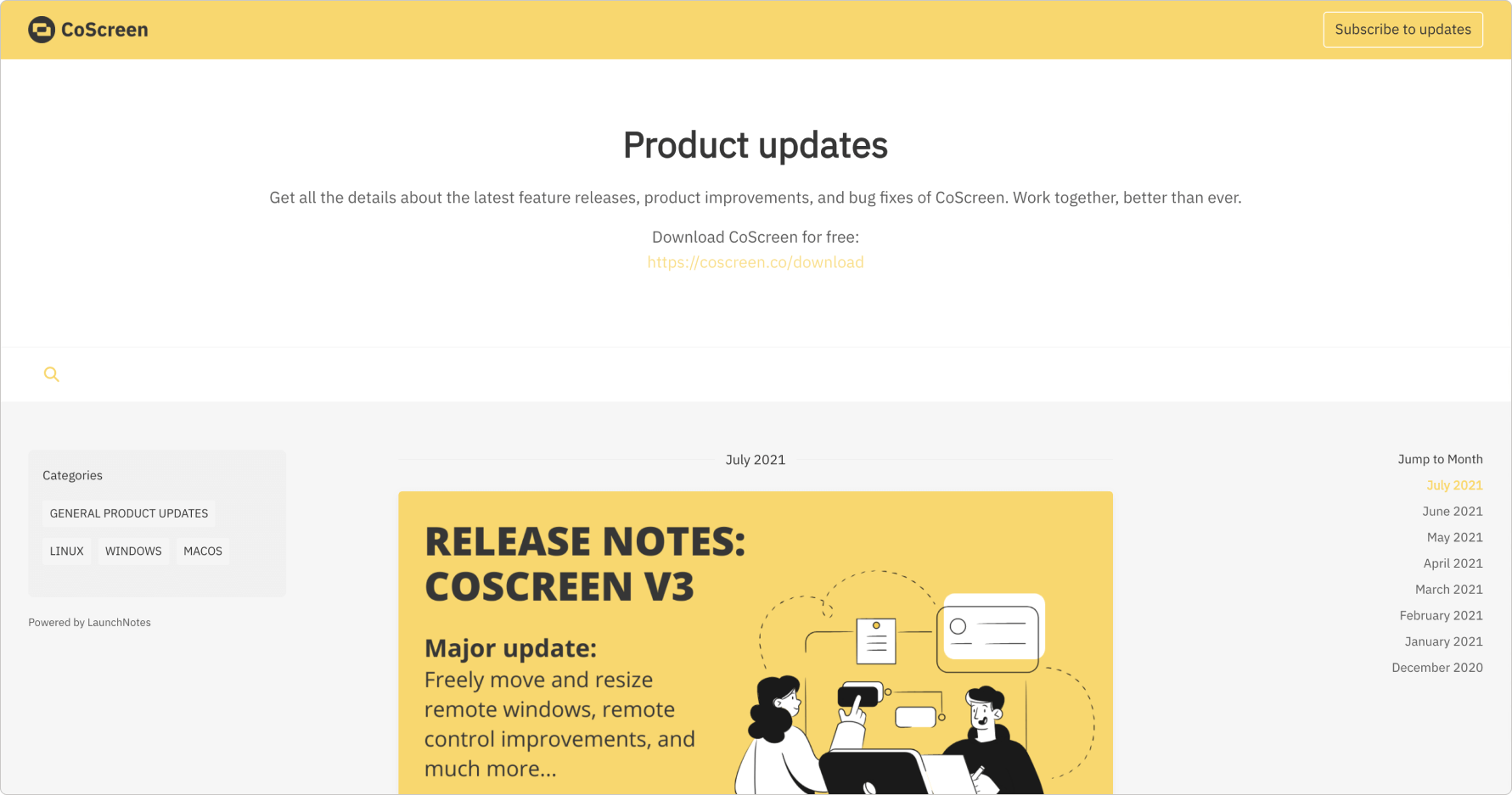
CoScreen release notes on LaunchNotes

How they use it

  • Write once, send everywhere: LaunchNotes turns each release note into a branded email for the right audience
  • A dedicated channel subscribers expect to hear from, instead of worrying about burning the email list
  • Their PMM arm: before hiring a product marketer, LaunchNotes let PMs communicate updates as fast as they shipped
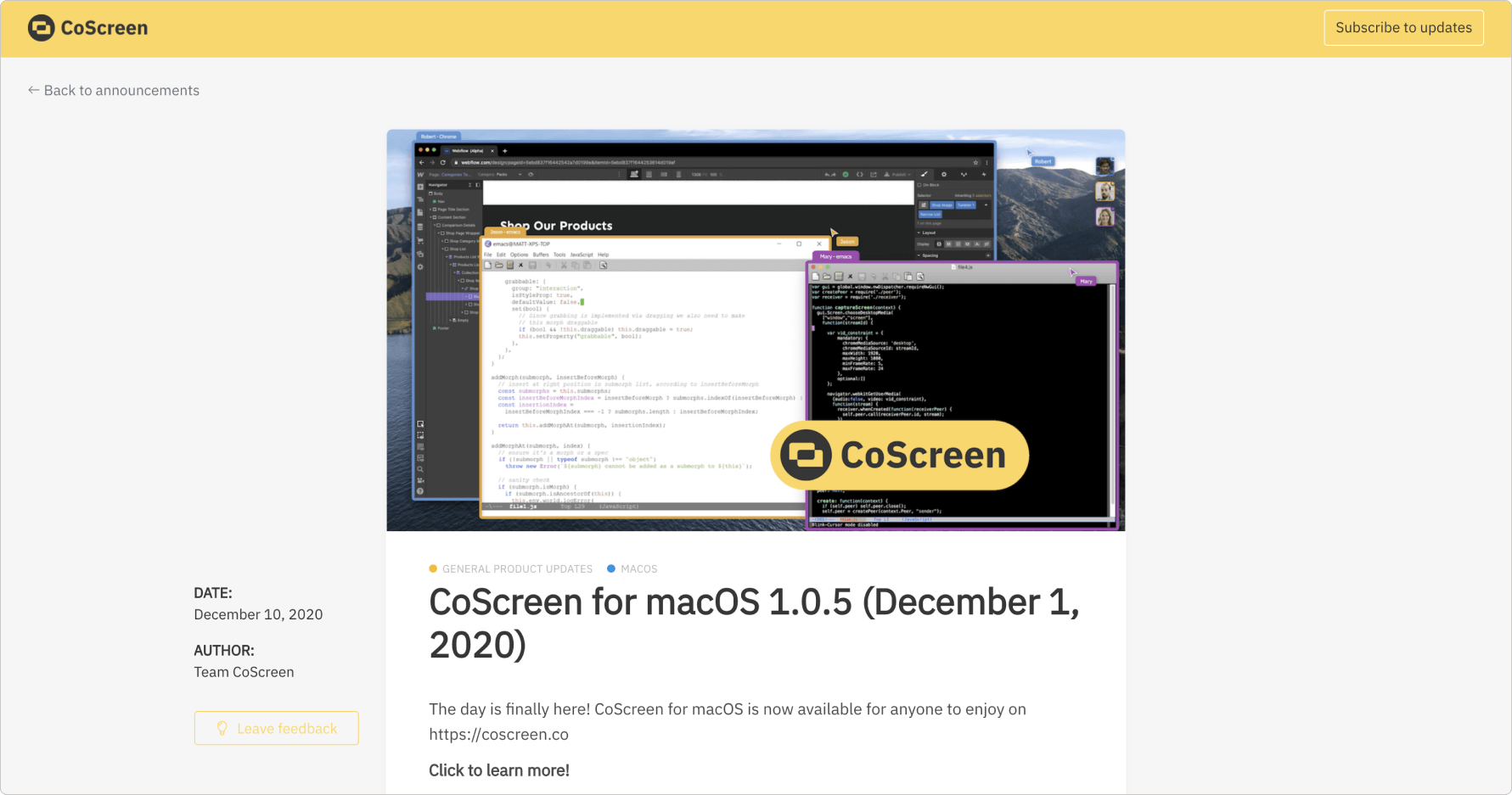
A CoScreen announcement on LaunchNotes

What changed

Release comms stopped slowing down each launch. “When I think about all of these productivity gains together, I can confidently say that LaunchNotes helped us ship at least 30% faster,” Max said.

When CoScreen did hire a PMM, the release process was already in place, so she could drive impact from day one. And as the team doubled in a year, LaunchNotes kept up. Max's one-word description: “Scalable.”
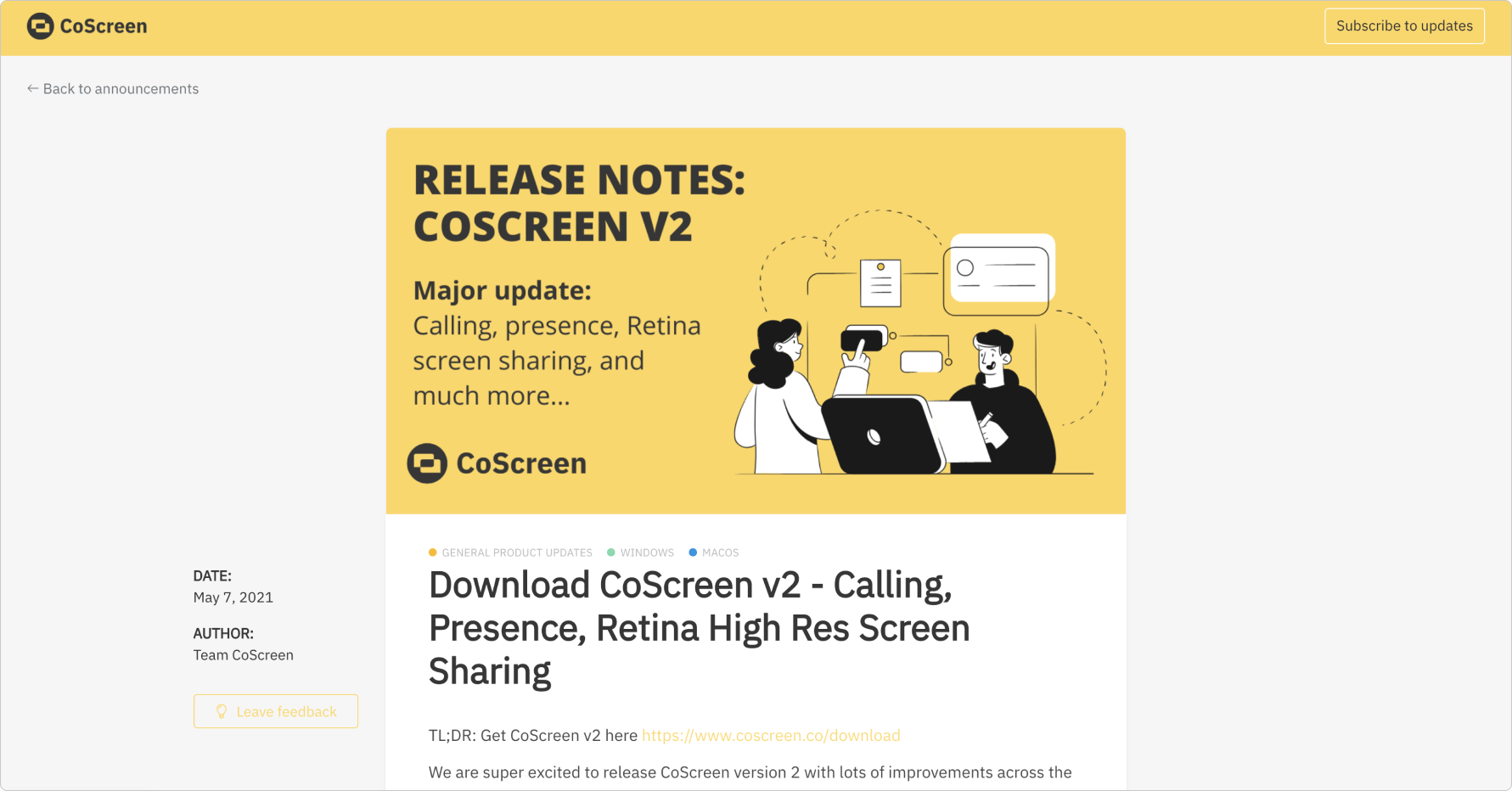
CoScreen release notes
Closing thought
Now that we manage product updates in LaunchNotes, I don’t know why you’d ever do it any other way.
Max Andaker, Chief Product Officer, CoScreen
Narmi
Eden

Frequently Asked Questions

CoScreen's efficiency gain of more than 30 percent came from replacing manual, general-purpose tools with a single branded hub that automates distribution across channels. That's the core pattern worth copying: stop hand-turning release notes into emails and let one published update do the work everywhere.

The fastest way to see whether it fits your own workflow is a demo, where an account executive can walk through how the same setup would save your team hours every week.

CoScreen wanted to communicate updates as quickly as it was shipping new software, and its previous email and Notion workflows could not keep up. Max Andaker described the team as stretched incredibly thin, with the step of communicating what shipped consistently falling through the cracks.

LaunchNotes closed that gap by making it possible to publish and distribute in one step, so shipping speed and communication speed stayed aligned. Andaker also noted how quickly it came together: up and running in under a week, and releasing features through it the week after.

Yes. CoScreen was a clear example of a small team punching above its weight on product communication. In the early days the platform effectively served as the company's entire product marketing arm, letting the product and engineering org stand up a real communication motion while they searched for their first full-time product marketing hire.

It delivered polished, well-targeted announcements with no dedicated marketing function in place, and when the PMM did arrive, having the process already dialed in meant she could step in and drive impact faster. For lean teams that still want a professional update process, that pattern holds up.

CoScreen eventually hired a full-time product marketer, and having the LaunchNotes launch process already in place let that person get up to speed much faster. Because the release comms motion was already dialed in, the new hire could step into the role and drive impact almost immediately.

This shows how a well-established communication process becomes an asset that compounds as a team grows. LaunchNotes gave CoScreen a repeatable foundation that made scaling the marketing function easier.

CoScreen highlighted the power and accuracy of the segmentation engine as a major benefit. The team ran separate apps for Mac and Windows, and needed a precise way to reach users of one without sending them updates about the other.

Categories in LaunchNotes solved it: Max Andaker said that when he saw custom categories he was sold, calling it a simple, powerful fix for a problem every product team faces. It also resolved the two friction points they had with email, which were never being sure which updates warranted a send, and never being sure each one reached the right audience.

CoScreen saved hours every week after switching to LaunchNotes, largely because the team no longer had to manually turn release notes into emails. Max Andaker described the value of that time saving as incalculable for a startup, on top of reducing release comms overhead by at least 30 percent.

The gain came from LaunchNotes handling distribution across channels from a single published update, and from auto-generating branded email templates out of that content, which Andaker called the biggest a-ha moment he had with the product. Reclaiming that time let a small team focus on building rather than repeating communication tasks.

When rolling out LaunchNotes, the first thing CoScreen did was make sure its LaunchNotes page matched the rest of its website. Max Andaker's reasoning was that as a startup scales, brand becomes an extension of the company and the product, and with their previous Notion setup they had never been able to brand updates at all.

The result was the best of both worlds: a purpose-built tool to announce updates that still looked and felt like a natural extension of the CoScreen brand. He called it a huge win for the team and an even bigger one for their customers.

Before adopting LaunchNotes, CoScreen relied on email as its main channel for communicating new products and features, and later published release notes in Notion. The team was not initially aware that more impactful, purpose-built solutions existed in the market.

Once they found LaunchNotes, they gained a dedicated platform designed specifically for release communication. This move away from general-purpose tools is a common turning point for teams that take product updates seriously.

In the early days of CoScreen, LaunchNotes essentially served as the company's product marketing arm before it had a dedicated hire. One of the most important jobs of product marketing is communicating product updates, and LaunchNotes let the small team do that in a highly efficient way.

This meant CoScreen could deliver professional, well-targeted announcements without a full marketing function in place. Using LaunchNotes as a stand-in product marketing capability is a powerful option for early-stage teams.

CoScreen reduced the overhead of its release comms process by at least 30 percent with LaunchNotes, and Chief Product Officer Max Andaker described the value of that time saving as incalculable for a startup. Replacing manual workflows with a purpose-built platform meant the team no longer had to tediously turn release notes into individual emails, and a single published update reached the right audience across channels automatically.

That let CoScreen communicate updates as quickly as it shipped new software, and freed up hours every week for higher-value work. CoScreen has since been acquired by Datadog.
