How Product Teams Generate Release Notes in 2026 and What Changed
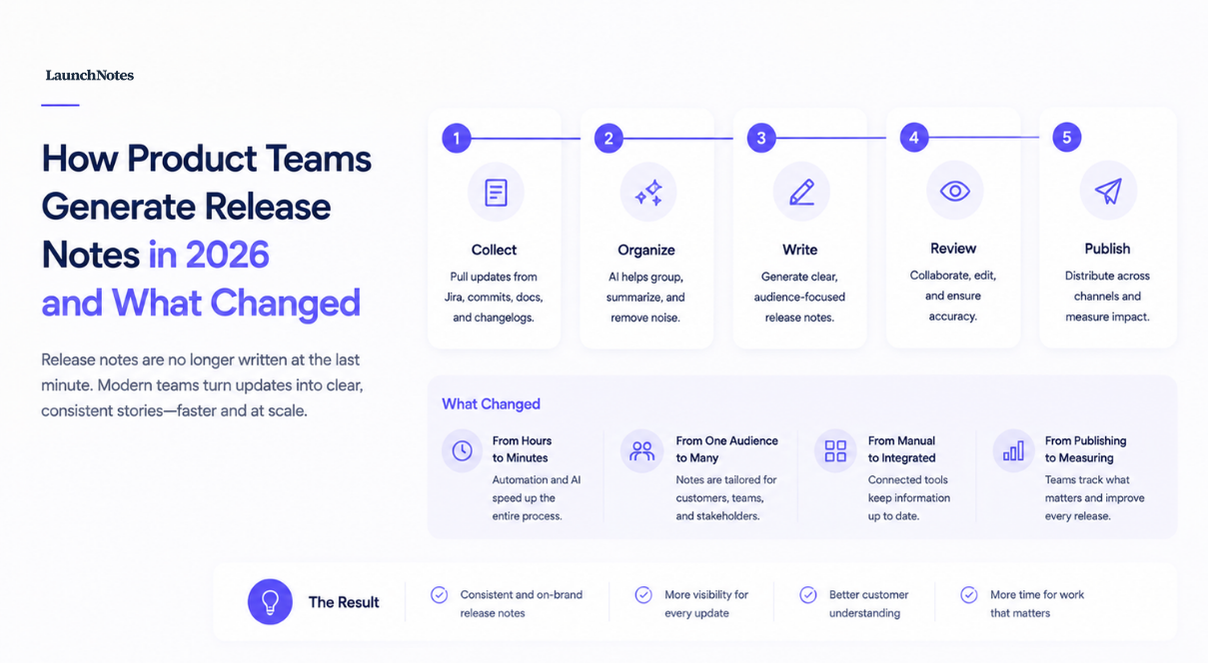
The interesting decision is not whether to automate release notes. Almost every team has automated something by now, whether that is a tag-triggered draft in a repository or an AI summary of a sprint's worth of tickets. The decision that actually determines quality is where in the workflow the words for readers get written: at the moment someone makes the change, or afterward, by a tool reading what version control happened to record.
What changes the answer is who the notes are for. A pipeline that produces a perfectly serviceable changelog for engineers upgrading a library will produce something close to noise for a customer success manager preparing for a renewal conversation, and no amount of model quality fixes that, because the problem sits in the inputs and the ownership model rather than in the generation step. Everything below follows from that split.
The Two Pipelines Teams Are Actually Running
Strip away tool names and two architectures remain, separated by the moment of authorship. In the first, someone writes for readers while the change is still fresh in their head: a release notes field filled in on a Jira work item, or the workflow one developer described in the Hacker News thread on automating release notes, where release notes go into a draft Markdown file in the same commit as the change, filed under headings such as Breaking or Changes. The artifact accumulates as the work happens, so the release itself is mostly a matter of publishing what already exists.
In the second architecture nobody writes for readers at all until after merge, and the tooling reconstructs a summary from what the repository already holds. GitHub's automatic release notes work this way, assembling a draft from pull request titles and the labels attached to them, which means the output inherits whatever conventions the engineering team happens to follow. When titles and labels are maintained consistently, the generated draft is genuinely usable as a starting point and the categorization lands where it should. When they are not, the same pipeline produces a list of merge summaries with a version number on top.
The deeper consequence of post-hoc generation is one of vocabulary rather than coverage. Commit messages and pull request titles are written by developers for developers reviewing code, so they name files, refactors, and internal components, and they optimize for traceability rather than for explaining what a customer can now do. Generating from that material does not remove the writing work; it relocates it to whoever has to rewrite the draft before publication, usually under release-day pressure. Annotating at development time front-loads that cost onto the people with the most context, while generating after merge defers it to the people with the least.
What Automation Tools Pull From and Why It Matters
Every generation approach has a quality ceiling set by the type of data it reads, and the ceiling is easier to see than the tooling differences that get most of the attention. Pull request labels are the clearest case: GitHub's categorization is only as good as the labeling discipline behind it, so a team that consistently distinguishes features from fixes from breaking changes gets a structured draft, while a team that labels sporadically gets one undifferentiated bucket no matter which generator sits downstream.
Work item data raises that ceiling because tickets already carry more human intent than commits do. Custom pipelines built on Azure DevOps take advantage of this by rendering Handlebar templates against work items and changesets, which gives a team precise control over grouping, field selection, and formatting, with OAUTH handling authenticated access to the services that hold the data. The control is real, and so is the maintenance burden: a template-driven pipeline is software that someone has to own, debug, and update every time the underlying fields or process change. A managed SaaS generation tool trades that control for someone else maintaining the plumbing, which is usually the right trade unless your grouping logic is genuinely unusual.
AI generation follows the same rule rather than escaping it. Feed a model a CSV export or a structured list of tickets and the output quality is bounded by how well those tickets were labeled and described in the first place; a model can smooth language, group related items, and drop obvious internal noise, but it cannot recover the customer-facing significance of a change that was never recorded anywhere. Before evaluating any generator, look at what your team writes without being asked, because the honest input inventory predicts the output better than a feature comparison will. On the delivery side, LaunchNotes centralizes release notes, roadmaps, and feature updates, and supports announcements, roadmaps, customer feedback, integrations, webhooks, GraphQL, RSS, and security features depending on plan, which matters mainly because the pipeline you build has to hand its output somewhere that the rest of the company actually reads.
Where Automation Breaks Down in Practice
The most common failure is not a broken integration but an unfiltered one. When every merged pull request appears in the published notes, readers outside engineering get a document that tells them a great deal about the repository and almost nothing about the product, and readers inside engineering are not much better served. Practitioners in the Hacker News thread on automating release notes are blunt about it; as one put it, All I can say is I hate when projects just lazily list every pull request for its change log / release notes. Volume reads as effort until someone tries to use the notes to answer a question.
The second failure is subtler and harder to argue with a dashboard. Generated notes tend toward the generic, because the generator applies the same treatment to a routine dependency bump and to the feature three enterprise accounts have been waiting on for two quarters. One commenter in the same thread compared automating release notes to playing a recording every time you introduce your child to somebody: the words are accurate and the occasion is lost. Significance is exactly what a generator cannot infer from a diff, and significance is the reason anyone reads a release note voluntarily.
Neither failure is an argument against automation. The same thread that criticizes lazy pull request dumps also produces broad agreement that the best notes are hand written by a thoughtful human, which is a statement about where judgment belongs rather than about tooling. Automation is reliable at the floor: assembling the complete set of changes, catching what someone forgot, enforcing consistent structure. Deciding what a release means for a given audience is editorial work, and pipelines that skip that layer publish their inputs.
The Audience Split That Most Pipelines Ignore
Two questions get answered by the phrase release notes, and they belong to different readers. One is what is new and why anyone should care, which is what customers, support teams, and go-to-market teams are looking for. The other is how to upgrade safely given what broke, which is what operators, integrators, and developers on your API need before they touch anything. Practitioners in the Hacker News thread argue for keeping the two apart, with one commenter writing simply, +1 on separating 'how to upgrade' due to breaking changes from 'what's new'.
Collapsing both into a single document fails both audiences at once. Customers wade through migration steps for interfaces they never call, while the engineer trying to plan an upgrade window hunts through feature copy for the one paragraph that determines whether the deploy is routine or risky. The failure is not cosmetic, since a missed breaking change becomes a support ticket or an outage, and a feature buried under upgrade instructions becomes a feature nobody adopts.
The practical remedy in the same discussion is to publish breaking changes as their own artifact, with a commenter noting that a project can and should publish a dedicated breaking changes file separately. Doing that gives the operator audience a single reliable place to look, on its own cadence, without diluting the announcement that goes to everyone else. The workflow implication runs upstream: once a team enforces the split as a rule about categories, the write-at-source habit of tagging each change as breaking or otherwise starts paying off, and automation can then target the right format for each output rather than producing one document that has to serve every reader badly.
Ownership and Timing Across the Development Workflow
Three ownership models show up in practice, and each buys something at a price worth naming. When the engineer writes at commit time, context is at its peak and nothing gets forgotten, but the writing carries the vocabulary of the implementation and every merge picks up a small tax that erodes under deadline pressure. When the product team writes after merge, the language improves considerably, at the cost of reconstructing intent from artifacts that were not written to explain intent, and at the cost of a single reviewer becoming the bottleneck that decides whether the release ships with notes or without them.
The third model, ticket annotation during development, is the compromise most teams land on: a release notes field gets filled in while the work item is open, then exported at release time from Jira and assembled into a draft. Sequencing the work that way keeps authorship close to the change while keeping the output in a system that product and marketing already use. The dependency is compliance, since a field that half the team fills in produces notes that are half complete, and the gaps are invisible until a customer asks about a change that never appeared anywhere.
Because compliance is the weak point, the useful investment is not a better generator but an explicit rule about who owns which surface. Name the person responsible for the customer-facing announcement and the person responsible for the breaking changes artifact, decide whether the annotation is a merge requirement or a best effort, and accept the consequences of whichever you choose. Teams that leave ownership implicit tend to default to whatever the pipeline emits, which is how the pull request dump gets published in the first place, and the broad practitioner agreement that the best notes come from a thoughtful human is only actionable if a specific human is on the hook.
Bridging Auto-Generated Drafts and Editorial Release Notes
The workable arrangement is two stages rather than a choice between them. Stage one is a scaffold, generated from pull request or ticket data, that guarantees completeness and consistent grouping: everything that shipped, sorted into categories, with links back to the underlying work. Stage two is the significance layer, where someone rewrites the entries that matter into user-facing language, demotes or drops the ones that do not, and adds the context a diff cannot contain, such as why a change was made and what a customer should do differently now.
AI has genuinely moved part of stage two, without moving the part that carries risk. Jira's Rovo AI drafting notes from ticket data automates a real portion of the translation from internal shorthand into readable prose, which shortens the editorial pass considerably when tickets are well written. Judgment about which three of forty changes lead the announcement remains a human call, because relative importance lives in customer conversations, roadmap commitments, and support volume rather than in the ticket tracker.
Skipping stage two has a predictable outcome: developer language reaching a customer-facing channel, complete with internal component names, ticket identifiers, and the occasional revealing commit message. Keeping a review gate between generation and publication is the cheapest insurance in the whole workflow, which is one reason product teams separate the system that assembles changes from the system that publishes them. LaunchNotes sits at that second point, centralizing release notes, roadmaps, and feature updates so the reviewed version is what customers and internal stakeholders actually receive.
What the Evidence Justifies Doing Now, Waiting On, and Reconsidering
Three actions are supported well enough by practitioner experience to take this quarter regardless of your current tooling.
- Write at source with categories, so that every change carries a reader-facing line and a classification at the moment it is made rather than at release time.
- Publish breaking changes as a separate artifact on its own cadence, following the practitioner recommendation to keep upgrade guidance out of the feature announcement entirely.
- Assign named ownership per output surface, because the pull request dump is a symptom of an undefined ownership model rather than of a bad generator.
Worth waiting on is unattended AI publication. Where input discipline is inconsistent, and it is inconsistent in most organizations that have not made annotation a merge requirement, a model will produce fluent notes that quietly omit the change your largest customer cares about, so human review before publication stays mandatory rather than aspirational. Also worth deferring is a heavily customized template pipeline, whether built on Handlebar templates over work items or on repository metadata, until labeling is reliable enough that the pipeline has something coherent to render. Building sophisticated formatting on top of inconsistent inputs produces sophisticated formatting of inconsistent inputs.
Worth reconsidering is the assumption that a generator attached to CI/CD can serve as your product communication channel. A build-time tool is well suited to the developer-facing changelog and to the breaking changes artifact, since both audiences want completeness and traceability. Customers, support, and go-to-market teams need edited announcements, a visible roadmap, and a way to respond, which is a different job with different reviewers and a different cadence, and running both from one output is how the audience split gets ignored. LaunchNotes supports announcements, roadmaps, customer feedback, integrations, webhooks, GraphQL, RSS, and security features depending on plan, so the generated draft can flow in through integrations while the published update stays an editorial decision.
The honest summary of the evidence is that automation has become very good at the part that was never the hard part. Assembling a complete list of changes is solved; explaining why a release matters to a specific reader is not, and the practitioner comparison of automated notes to a replayed recording lands because generic accuracy is not the same as communication. Teams that get this right in 2026 look less like teams with a better generator and more like teams with a clear rule about who writes for whom, and when. If you want to see how that division of labor works once the drafts have somewhere to go, book a demo and bring your current pipeline with you.
Release notes are kind of our thing, and the pattern we keep seeing is the same: the pipeline is rarely the constraint, and the ownership model almost always is.