How to Build a Product Launch Communication Plan That Keeps Every Team in the Loop
What This Plan Actually Requires Before You Start
A product launch communication plan covers wider territory than a marketing plan. Marketing owns demand generation and external positioning, but the communication plan governs who says what, to whom, in what order, across every audience that touches the launch. That includes engineering, support, sales, channel partners, and customers. Treating the two as the same document is how sales reps end up fielding prospect questions about a feature they learned about from a press release ten minutes ago.
Building this from scratch takes four to six weeks of cross-functional coordination before any content gets drafted. If you're retrofitting a launch already in motion, the minimum is a messaging hierarchy and a communication RACI, both described below, plus an honest audit of what's already been said to whom. The tools are less important than the agreement: you need a single place where every stakeholder can see what's been communicated, what's coming, and who owns each message. Without that, the plan stays aspirational.
Preparation: The Inputs Your Plan Cannot Live Without
Three structural inputs separate a communication plan that actually ships from one that lives in a slide deck nobody revisits.
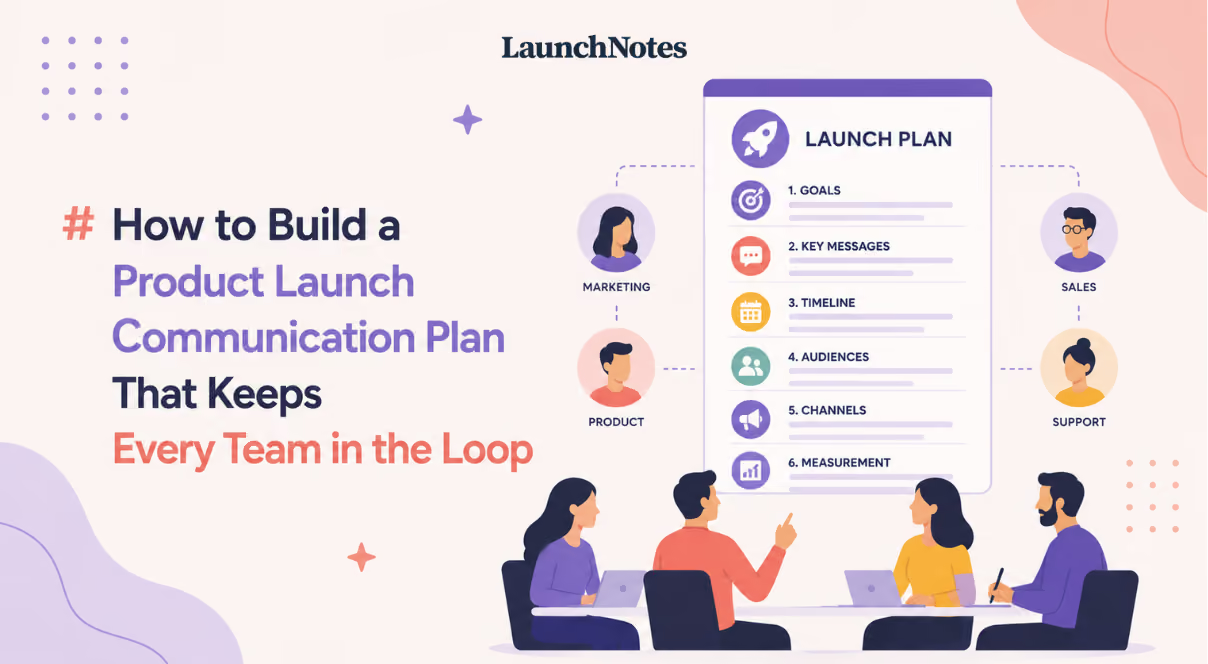
The first is an audience inventory. Product launch teams span engineering, marketing, sales, supply chain, and customer support, and each group needs a different version of the same core narrative. A support agent doesn't need the competitive positioning deck; a channel partner doesn't need the sprint retrospective. Map every audience, internal and external, and note what each one needs to know, when they need to know it, and what format they'll actually consume.
The second is a messaging hierarchy. Start with the core narrative: a short, plain statement of what the product does, who it's for, and why it matters now. Then cascade that into audience-specific versions. The sales version emphasizes differentiation and objection handling. The support version emphasizes known limitations and workaround paths. The customer version emphasizes the outcome. If these versions aren't written down and approved before anyone starts building slides or drafting emails, each team will improvise its own, and the inconsistencies will surface at the worst possible time.
The third is a communication RACI. For every message type, name who is responsible for drafting it, who approves it, who delivers it, and who needs to be informed after it goes out. A McKinsey cross-industry product launch survey found that team collaboration was the most important capability correlating with launch success. The RACI is how collaboration becomes operational rather than aspirational.
Building the Product Launch Communication Plan Phase by Phase
The phases below follow a through-line: internal alignment first, then pre-launch content and channel work, then sales and partner readiness, then launch day and the post-launch cadence that sustains adoption. Each phase feeds the next. Skipping internal alignment doesn't save time; it moves the confusion downstream where it's more expensive to fix.
Phase 1: Internal Alignment (Six to Three Months Out)
Internal alignment is a sustained briefing cycle that starts six to three months before launch and doesn't end until every customer-facing team can articulate the core narrative without reading from a script. According to the Corporate Executive Board, the top three challenges impeding a successful product launch are product planning, internal communications, and product launch execution across teams and stakeholders. Two of those three are communication problems.
Start by briefing engineering and product on the positioning, because they'll flag misalignment between what marketing plans to promise and what the product actually does at launch. Then brief support and sales, in that order, because support needs lead time to build documentation and sales needs the positioning to be stable before they internalize it.
Build a feedback loop into this phase. If a sales lead hears the positioning and says "that's not how our prospects think about this problem," that feedback needs a path back to the plan owner, not a side conversation that gets absorbed silently. A shared product roadmap that the whole team can reference helps here. When the narrative and the roadmap are visible in one place, misalignment surfaces early enough to fix.
Phase 2: Pre-Launch Communication (Three Months to One Week Out)
This is where the content calendar takes shape. Three months before launch, map every deliverable against a timeline: blog posts, email sequences, social assets, sales collateral, support documentation, and internal status updates. For each deliverable, note the channel, the owner, the approval path, and the go-live date.
Channel selection matters less than channel sequencing, which gets its own section below. One principle applies here: internal channels activate before external ones, always. The failure mode is familiar. A press release or public announcement goes live before sales reps have been briefed, and a prospect mentions the new feature on a call the rep wasn't prepared for. That credibility gap is hard to close.
Release notes and roadmap updates aren't just external artifacts. During pre-launch, they serve as internal communication tools that keep engineering, product, and support aligned on what's shipping, what's been cut, and what's been deferred. Strong release notes examples show how even a short update can carry the narrative forward for multiple audiences at once. Treating these updates as living documents rather than launch-day deliverables keeps the whole team current without requiring another meeting.
Phase 3: Sales, Support, and Partner Readiness
Sales and channel partner readiness is a distinct communication workstream with specific deliverables: battlecards that map your positioning against competitors, objection-handling guides built from real prospect conversations, support documentation covering known limitations and workarounds, and a confirmed briefing window that lands before any external announcement.
The briefing window is non-negotiable. Sales reps need at least two weeks with the final positioning and collateral before prospects can see it. Channel partners often need more, because they're translating your narrative into their own sales motion. If the timeline doesn't allow for that buffer, the launch isn't ready, regardless of what the product roadmap says.
This phase is also where the soft launch fork appears. A soft launch limits the audience to a controlled group, usually existing customers or a single segment, and the communication obligations are narrower: targeted emails, in-app notifications, and direct outreach rather than public announcements. A full public launch activates every channel simultaneously. The decision between the two should be made explicitly and documented in the plan, because it changes the scope of every deliverable downstream.
Phase 4: Launch Day and Post-Launch Reinforcement
Launch day is execution. If the plan is built correctly, every message is drafted, approved, scheduled, and assigned. The launch owner's job on the day itself is monitoring: watching for channel misfires, fielding escalations, and confirming that each message went out in the right order to the right audience.
The real work starts after launch day. Product launch communication is fundamentally about adoption. A feature that ships to applause and then disappears from the conversation doesn't drive adoption; it drives support tickets from confused users who heard about it once and can't find it. Post-launch communication should include a regular cadence of release notes, feature updates, and feedback collection. That cadence is the mechanism by which adoption is measured and sustained.
The done state for a product launch communication plan isn't "launch day went smoothly." It's a repeatable communication cadence, built from templates, channel assignments, and RACI ownership, that doesn't require rebuilding from scratch for the next launch. A platform that centralizes release notes, roadmaps, and feature updates across product, engineering, support, and customer-facing teams makes that repeatability possible. LaunchNotes is built for exactly this workflow, giving teams a single place to manage announcements, collect feedback, and maintain the post-launch cadence through Slack and email notifications.
How to Sequence Channels So the Right People Hear It First
Channel sequencing is a strategic decision. The order in which audiences learn about a launch carries trust implications that are difficult to reverse.
A sequencing model that works for most SaaS launches follows this order:
- Internal team notifications via Slack, email, or an internal product hub, covering what's launching, what's changed since the last briefing, and what's been deferred.
- Sales and support briefings with final collateral, objection-handling guides, and a Q&A window.
- Channel partner notifications with co-marketing assets and their own briefing window.
- Customer-facing announcements via email, in-app notifications, and release notes.
- Public channels: blog posts, social media, press releases, and community posts.
When this order gets reversed, the consequences cascade. A customer who sees a public blog post before their account manager can explain the feature feels like an afterthought. A sales rep who learns about a launch from a prospect's forwarded email loses credibility in that conversation and every one after it. A support agent who gets their first ticket about a feature they haven't been briefed on can't help the customer and can't escalate cleanly. Each of these is a trust cost, and trust costs compound.
The sequencing doesn't need to be days apart. Even a few hours of lead time for internal teams before external channels go live is enough to prevent the worst failures. The key is that the product launch communication plan documents the sequence explicitly and the launch owner enforces it.
When the Launch Slips: Communication Decisions Under a Delay
Delays happen. The communication plan needs a protocol for them, because silence is a communication choice, and it's almost always the wrong one.
For internal teams, communicate the delay as soon as the decision is made, not after a new date is confirmed. Teams that have been preparing collateral, documentation, and briefing schedules need to know immediately so they can pause work and reallocate time. The message should include what changed, why, and what the next decision point is. "We'll update you when we know more" is a vacuum that gets filled with speculation, so name the next checkpoint instead.
For channel partners, the calculus is similar but the stakes are different. Partners may have built their own marketing around your launch date. A delay communicated late erodes the relationship in ways that affect the next launch, not just this one. Give partners the same information you give internal teams, adjusted for what they need to act on.
For customers, the decision depends on whether you've already communicated a date publicly. If you have, acknowledge the delay directly and give a revised window. If you haven't, you have more flexibility, but don't use that flexibility to go silent. Customers who were told "coming soon" and then hear nothing will fill the gap with their own assumptions, and those assumptions are rarely generous.
Measuring Whether the Communication Plan Worked
The signals that matter are communication metrics: did the right people know the right things at the right time?
Internal readiness is the first signal. If support ticket volume spikes in the first two weeks post-launch with questions that the documentation already answers, the internal communication failed somewhere. If sales reps report that prospects are asking about features they weren't briefed on, the sequencing broke down.
Customer engagement with release notes and announcements is the second signal. Open rates and click-through rates on launch emails are useful, but the stronger indicator is whether customers are engaging with the ongoing cadence of updates after launch day. Feedback volume serves as a proxy for awareness: customers who know about a feature and have a channel to respond will use it.
The done state for the plan is a set of templates, channel assignments, and ownership records that the next launch can inherit. If the team has to rebuild the communication infrastructure from scratch every time, the plan didn't work, even if the launch itself went well. For teams looking to build that repeatable infrastructure, LaunchNotes offers a way to explore what a centralized communication platform looks like in practice. Book a demo to see how it fits your workflow.