Why Product Announcements Get Lost When Every Team Owns a Different Channel
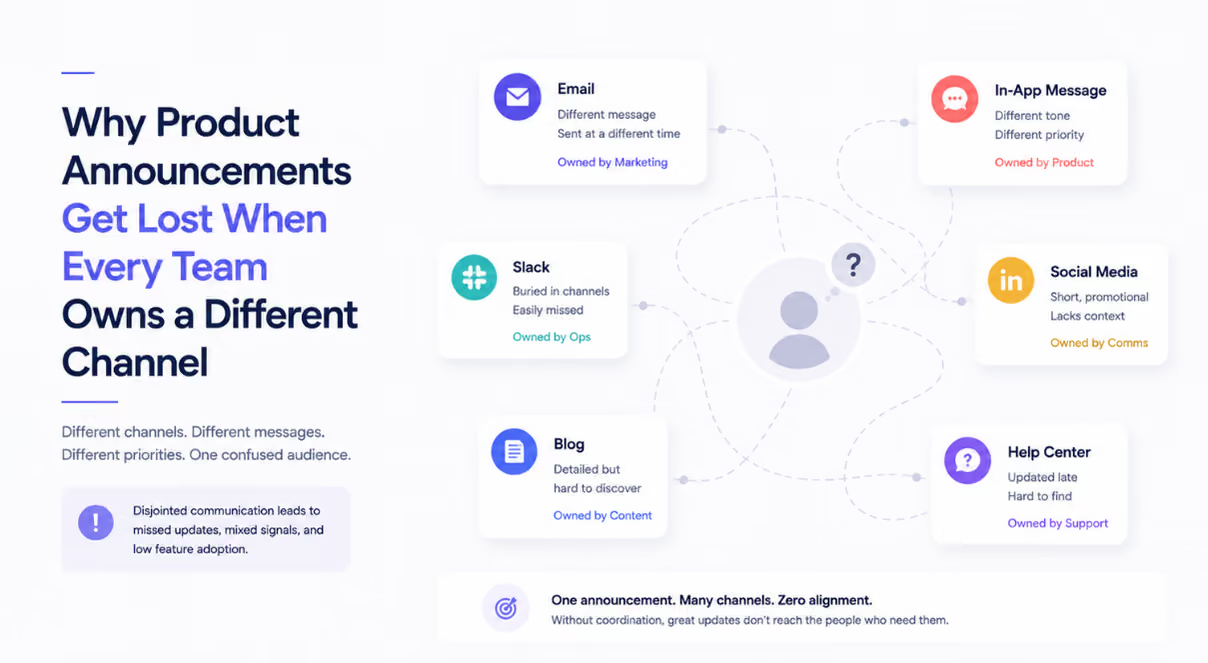
A release goes out on a Tuesday. Product marketing sends the customer email it drafted the week before, the product manager appends the shipped ticket titles to the changelog, support rewrites a help center article so the screenshots match, and a customer success manager forwards a slightly different version of the news to the handful of accounts most likely to care. Each of those messages is defensible on its own terms. Together they are four announcements about one release, carrying four framings and four timestamps, with nobody holding the whole picture.
The usual diagnosis is that the writing needs work, so teams invest in better copy, tighter headlines, and a nicer template. The actual failure sits upstream of the writing: ownership is split by channel instead of by release, and once that split hardens, no amount of editing will make the announcements add up. Fixing it means changing who decides what goes where, and in what order, before anything gets published.
The Fragmentation Problem Hiding in Plain Sight
In most software companies the announcement surface has been quietly divided up by whoever needed it first. Product marketing owns the customer email list and the launch blog. Product management owns the changelog and whatever in-app messaging the codebase supports. Support owns the help center and the macros that answer questions about new behavior. Customer success owns the relationship emails that go to named accounts. Because each team controls its own channel and sets its own cadence, there is no shared record of what went out, when it went out, or who received it.
The consequences show up in both directions. Minor updates get announced two or three times because nobody knew the others were sending, while genuinely significant changes get thin coverage because each team assumed a different team was handling the heavy lift. Support feels it most acutely: when the support queue has no visibility into marketing's send schedule, agents field tickets about features that were already announced, and they answer them from a help article that was written against a slightly older version of the release. Measurement suffers just as much. If feature adoption in the two weeks after an announcement is the number that matters, and the source "How To Craft The Best Product Updates" treats adoption within 14 days as the primary success metric, then four uncoordinated sends make the result impossible to attribute to anything.
Four Causes Worth Diagnosing Before Picking a Fix
Fragmentation is rarely one problem. It is usually four, and they compound, which is why teams that solve only the visible symptom find themselves back in the same place two releases later.
The first cause is the absence of a triage standard. When nothing defines what counts as a major update versus a routine improvement, every team makes that judgment independently and picks a channel to match its own judgment, so a permissions change that will break an integration gets the same treatment as a copy tweak. The second is the missing internal alignment step. Without a deliberate pause between "the release is ready" and "the announcement goes out," sales and support learn about changes from customers, which is the least recoverable way to learn anything. The third is treating channel selection as a design preference rather than a function of impact; the guidance in "How To Announce Product Updates In 2026 (and why Less is More)" is to reserve modals for major updates and use tooltips for contextual ones, and teams that interrupt the workspace for every small change train users to dismiss the modal that finally matters. The fourth is treating the changelog as a passive archive, a place where shipped work goes to be filed, when it can operate as an active communication layer that customers return to because it consistently tells them what changed and why.
All four causes share a root. Nobody has answered the two questions that should precede any send, which the same source puts plainly: First things first: Why are you announcing, and who even cares? Answer those before drafting, and triage, channel, and audience mostly resolve themselves. Skip them, and each team answers by default, using the channel it happens to own.
Signs Your Product Announcement Process Is Already Broken
The causes above are structural and therefore hard to see from inside a release cycle. Their symptoms are not, and each one points at a specific missing piece rather than at general disorganization.
- Support volume spikes in the days after a release, with tickets asking about changes the team considered fully announced. The missing piece is the internal briefing that should have reached agents before customers saw anything.
- The changelog entry and the customer email describe the same feature differently, or one mentions a limitation the other omits. The missing piece is a single source of truth for announcement content, so each channel got drafted from someone's memory of the release.
- A salesperson cannot answer a straightforward question on launch day, or worse, promises behavior the release does not include. The missing piece is go-to-market's place in the announcement workflow, which usually means the workflow ends at publish rather than at readiness.
One of these signals in isolation might be a bad week. Two or three appearing every cycle means the process is not underperforming, it is functioning exactly as designed, and the design is channel ownership without a coordinating layer.
Fixes That Do Not Require New Software
Before evaluating tooling, run a cycle or two on process alone, because tooling installed on top of an undefined process just automates the confusion. Start with a triage rubric that assigns a channel tier by audience impact rather than by engineering effort. Three tiers is usually enough: changes that alter existing workflows or pricing, changes that add capability users need to discover, and changes that only need to be on the record. The rubric decides the tier, and the tier decides the channels, which removes the per-release negotiation that produces both duplicate sends and silent releases.
Next, make the internal briefing a required step that happens before any external send. Support and sales get the full detail, including known limitations, the questions likely to arrive, and the accounts most affected. The external announcement then gets drafted from the impact rather than the implementation, following the same guidance to Lead with user impact, not the feature name. Finally, give one person per release cycle the authority to approve the external publish. Not to write everything, and not to attend every meeting, but to confirm that triage happened, the briefing landed, and the channels match the tier.
Two cycles of that discipline will teach you more than any vendor evaluation, because the gaps that survive a working process are the gaps worth buying software to close. Usually they are the same ones: reformatting the same content by hand for every channel, no record of what a given customer segment actually received, and no way to see adoption after the send.
What a Single Source of Truth Actually Needs to Do
Most teams reach for a shared document first, and a shared document does one of the four necessary jobs. It stores the canonical content, so the changelog and the email stop contradicting each other. What it cannot do is enforce the sequence. A document will happily let someone publish externally before support has been briefed, because a document has no opinion about order of operations, whereas a purpose-built product communication workflow can make the alignment step a structural precondition of publishing rather than a cultural norm that erodes under deadline pressure.
The second job is formatting from one entry. Manual reformatting for email, in-app messaging, and the changelog is where the wording drifts and where the modal-versus-tooltip decision quietly reverts to whatever is easiest to ship, so a single content record that renders correctly per channel protects both the message and the triage rubric. The third job is history that customers can browse. When past updates live in a durable, public place, customers answer their own questions about what changed in March instead of opening a ticket, which pulls load off support rather than adding to it. The fourth job is measurement tied to the announcement itself, because adoption in the 14 days after publishing is the number that tells you whether the send worked, and it is only interpretable when one record can be traced to one set of channels and audiences.
Sequencing a Multi-Channel Product Announcement From One Record
Once the content lives in one place, a release becomes three distinct moments rather than four competing ones, and each moment has a different audience and a different level of detail.
- The internal briefing, before anything external ships. Full technical detail, edge cases, known limitations, migration notes, and the answers support will need on day one. Nobody outside the company reads this version, so it can afford to be dense.
- The launch-day publish, drawn from the same record but rewritten to lead with what the change does for the user. Channel follows tier: a modal for the major update that alters how someone works, a tooltip for the contextual improvement they will meet in place, and a changelog entry in every case so the record stays complete.
- The follow-up, timed to the 14-day adoption check. Adoption inside that window is the metric that tells you whether the announcement landed, and it also tells you who to talk to next.
The follow-up is where most teams give back the discipline they just built. Sending it to the entire user base reannounces the feature to everyone who already adopted it, which is precisely the behavior that trains customers to ignore product announcements in the first place. Send it only to the segment that has not tried the feature, and the second message stays relevant to the people receiving it while the adopters are left alone. Segmenting that way depends on knowing who received the original send and who acted on it, which is the difference between a source of truth that stores content and one that also carries audience and outcome.
Where LaunchNotes Enters the Workflow
The process work above establishes triage, briefing, and ownership. What it cannot do on its own is hold the record, format it per channel, and keep the history in one durable place, which is the layer LaunchNotes is built for. LaunchNotes centralizes release notes, roadmaps, and feature updates, and it supports announcements, roadmaps, customer feedback, integrations, webhooks, GraphQL, RSS, and security features depending on plan, so the announcement stops being four drafts in four tools and becomes one record with several outputs.
The teams named in the fragmentation problem are the same ones the platform is built to serve: product marketing, product management, product operations, engineering, support, customer success, and the wider go-to-market group. Coverage matters here, because a coordinating layer that reaches only marketing and product recreates the original split with fewer participants.
One practical caveat before you scope anything: capabilities are tiered, so map the specific requirements from your own process work against the current plan details rather than assuming everything is available everywhere. If you want to see how the sequencing above behaves against your release cadence, book a demo and walk through a real recent launch instead of a hypothetical one.
The Decision That Determines Whether the Fix Holds
Every element described so far survives or fails on one decision: who owns the announcement, by name, with the authority to hold a publish. Leave that role unstaffed and the reversion is predictable. Within two or three cycles, teams go back to self-publishing on the channels they control, because a release is time-sensitive and an unowned process is the first thing people route around when the clock is tight. The rubric will still exist in the wiki. Nobody will consult it.
Where to put the role involves a real tradeoff. Assign it to a single team and the announcements bend toward that team's channel: product marketing tends to over-index on the email and the launch moment, product management on the changelog and the completeness of the record, support on the questions the change will generate. Assign it to a committee and you trade channel bias for decision latency, which is the worse failure for anything time-sensitive, since a security-relevant change cannot wait for consensus on tier and framing. The workable middle is a named owner per release cycle with a written escalation path, rotating between product marketing and product management often enough that neither perspective becomes the default and rarely enough that the owner learns the job.
The rubric needs the same maintenance discipline. Review it at the end of each cycle against what actually shipped, because release cadence moves and a tier definition written when you shipped monthly will misclassify half of what you ship weekly. When the rubric drifts, the symptoms return in their original form: modals for trivia, silence around the changes that break workflows, and support learning about a release from the customer who found it first. Keeping the owner staffed and the rubric current is unglamorous work, and it is the whole reason a coordinated announcement process holds beyond the quarter in which someone decided to build one.